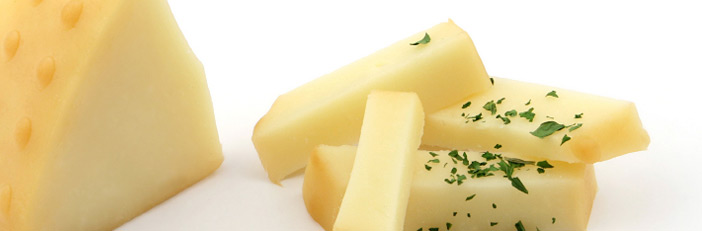
California has been producing cheese for as long as it has been making wine - more than 200 years. Today, California has more than 50 cow's milk cheesemakers who produce 250 varieties and styles of cheese that are increasingly available in grocery stores, specialty markets and cheese shops nationally. Many of these cheeses have won awards in recent years, both in the United States and abroad.
Definition
Natural cheese is a term used to describe cheese that is made from milk to which salt, enzymes and flavorings can be added. It is the result of the fermentation of milk by adding starter culture. Cheese is one of mankind’s oldest foods and is a way of preserving the nutrients in milk in a delicious form.
The Facts
The evolution of cheese dates back 5,000 years when people learned to preserve naturally curdled milk by draining off the watery whey then salting the curds to flavor and preserve them. At some point it was discovered that the texture of the curd became more pliable with the help of the enzyme rennet, which naturally occurs in animal stomachs. The growth and activity of enzymes in cheese caused it to develop and change. It was later discovered that some cheeses could be aged and kept for months or years.
The Process
Cheese is made by adding acid or starter culture to milk, causing the sugar in the milk to ferment. Curdling (coagulating) milk causes it to separate into semi-solid curds and liquid whey. The type of cheese produced is determined by a number of factors including the type of culture, the amount of whey remaining in the curds, how the curd is worked after whey drainage, the amount of pressure applied to the curds, and if the cheese is intended to be fresh or aged. In the case of aged cheese, the curds are stirred and in some cases heated, then the whey is drained and the remaining curds are salted and pressed to form cheese. Fresh cheeses, on the other hand, can be made from uncooked or cooked curd, drained of whey to varying degrees, and formed or unformed. Fresh cheeses are made to be consumed immediately while aged cheeses can be ripened for a period of time ranging from weeks to years. Cheese can be made from whole milk (full fat), 2 percent fat (reduced-fat), 1 percent fat (lowfat), nonfat or a combination of these milks. Some cheeses require that the milk be enriched with cream. Most cheese in the U.S. is made from cow’s milk.
Natural cheese is a living food that over time will continue to change in flavor and texture. One way to categorize the hundreds of cheese varieties made today is according to their moisture or degree of softness or hardness. For instance, cheese varieties range from fresh to soft and semi-soft, hard or grating. Cheese can also be categorized by the type of rind, such as rindless, natural rind and surface ripened.
Storage and Handling
When purchasing cheese, make sure the package is properly and tightly wrapped and sealed, and that the cheese inside looks appealing. Do not purchase any cheese that looks dry or discolored, as the package seal may be broken. With fresh cheeses, check the freshness date on the package. Most cheeses will maintain their flavor and quality in your refrigerator if properly stored. Keep cheeses in the refrigerator until needed. Once opened, follow these simple guidelines for storing cheese:
- Fresh cheeses should be treated just like milk and kept refrigerated. Many fresh cheeses can last for a few weeks if properly stored, so note the freshness date on the package before you buy. If you detect mold on a fresh cheese, discard it.
- Soft-ripened cheeses will keep for up to several weeks if properly stored. If you plan to use a soft-ripened cheese within a few days, store it in the refrigerator in its original plastic wrap.
- Semi-hard and hard cheeses can remain enjoyable for four to eight weeks if properly stored. If you do not plan to consume these cheeses within a few days after its original package is first opened, consider removing their original plastic wrap and re-wrapping in parchment or wax paper, which allows the cheese to breathe. After re-wrapping a cheese, store in a covered plastic container or an open resealable-type food storage bag. Open the bag a couple times a week to let in fresh air. If a small patch of mold appears on a piece of cheese, trim it off completely by cutting at least 1/4-inch below the mold and plan to consume the cheese soon.
- Very hard cheeses (typically used for grating) are much lower in moisture than other cheeses and will keep for months stored in the same way as semi-hard cheeses.
Nutrition
- One ounce of natural cheese such as Cheddar, Jack or Mozzarella contains approximately 20 percent of a person’s recommended daily calcium intake.
- Those who are lactose-sensitive or lactose-intolerant can still enjoy cheese as long as they eat natural hard (aged) or soft-ripened types, which contain little or no lactose.
Cooking with Cheese
- To melt cheese, use a low temperature for a short time. Hard cheeses can withstand higher cooking temperatures than soft cheeses. Shred, grate or cut cheese into pieces before melting.
- Hard cheeses such as Dry Jack, Aged Cheddar and Parmesan are ideal for cooking and baking.
- Add cheese toppings to food at the end of baking or broiling and heat just long enough to melt.
- Soft and soft-ripened cheeses have enough water to make them blend well into soufflés, custards and fillings; remove the rind before using.
- If cheese is heated at too high a temperature or for too long, it may become rubbery or stringy. Add cheese as the last ingredient in a sauce or soup and heat just until melted.
- Minimize stirring, which can cause the cheese to become lumpy.
- Blue and pungent cheeses should be added sparingly since they tend to melt quickly and burn easily. In baking, chill cheese before grating and adding to pastry dough.
- Weight is the best method to measure cheese for recipes: 4 ounces of natural cheese equals 1 cup shredded cheese (1 ounce = 1/4 cup).
Glossary of Terms
Brine is a saturated solution consisting of salt and water used to wash and salt some cheese varieties during cheesemaking. Brine is used to begin forming a rind on cheese and to help inhibit the growth of undesirable bacteria. Brining refers to the process of immersing the cheese in brine, allowing it to slowly absorb salt over time.
Cheddaring is a cheesemaking technique, used for Cheddar and some other types, where the drained curds are allowed to mat and knit and then are stacked on top of each other and turned at regular intervals. Cheddaring helps to raise the acidity level in the curd and converts the curd into a firmer structure before milling and pressing.
Curds are the semi-solids formed in curdled (or coagulated) milk from which cheese is made.
Mold is a member of the fungi family that appears on some cheeses by design and on others as a result of improper handling or storage. In certain types of cheese, mold growth – either on the rind or inside of the cheese – is essential to proper flavor and texture development. Most molds that grow on the surface of cheese are harmless and can easily be removed by cutting at least 1/4-inch beneath the mold before consumption. It is best to prevent mold growth on cheese (in which mold is not desired) by properly packaging cheese.
Natural Cheese is a term used to describe cheese that is made from milk to which salt, enzymes and flavorings can be added. It is the result of the fermentation of milk by adding starter culture, making it a food that changes in flavor and texture over time.
Pasteurization is a process of heating raw milk to a specific temperature for a set period of time to destroy disease-causing and other undesirable organisms. Legal pasteurization temperature is 161?F for 15 seconds or 145?F for 30 minutes.
Raw Milk is milk that has not been pasteurized. (See Pasteurization) In the U.S., cheese made from raw milk must be aged at least 60 days at temperatures no less than 35?F before consumption.
Rennet (Chymosin) is a milk-clotting enzyme added to coagulate milk. Rennet can be either of animal origin (e.g. enzyme from a calf stomach) or microbial origin.
Rind is the outer surface of cheese that creates a seal and helps control moisture loss during ripening.
Starter Culture consists of selected strains of harmless living bacteria – mostly lactic acid bacteria – that are added to milk as one of the first steps in the cheesemaking process in order to preserve the nutrients from spoilage through controlled fermentation.
Whey is the liquid byproduct of producing cheese. Because whey contains significant proteins, lactose and minerals, it is increasingly being used as an ingredient in producing other foods. Whey is often used to make Ricotta.
Sources:
- California Department of Food and Agriculture
- McGee, Harold. On Food and Cooking. New York: Scribner, 2005
- National Dairy Council