A Definition
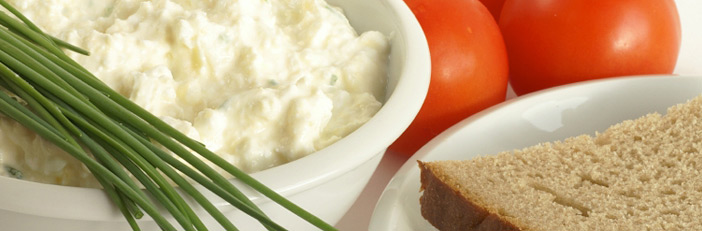
Cottage cheese is a fresh cheese with a mild, slightly acidic flavor and small curds. Cottage cheese is part of the family of fresh cheeses that are rindless and not intended to be ripened or aged in order to develop flavor.
The Facts
Cottage cheese is thought to be the first cheese made in America. For centuries, farmers in Europe made fresh farmhouse cheeses with naturally soured milk, after separating the curds from the whey. Immigrants to America brought the tradition of fresh cheesemaking with them and by the mid-1800s the term cottage cheese entered the American vocabulary. Cottage cheese is sold both plain and with added flavorings such as fruit and herbs.
The Process
Cottage cheese is made by adding an acid to pasteurized milk which causes a separation of the milk solids from the whey. This can be done by adding a bacterial culture that produces lactic acid or a food-grade acid such as vinegar. After the curd is formed, it is gently cut into pieces that allow additional whey to drain from the curds. The curds are further cooked and pressed gently to expel more whey. The curds are rinsed and salt is added.
Storage and Handling
- Store cottage cheese in its closed container in the refrigerator, which is typically set at 38˚F-40˚F.
- All cottage cheese products are stamped with a “sell by” date, which refers to how long the retail store can keep the product for sale on the shelf.
- If any mold forms on the surface of the cottage cheese, discard it immediately.
Nutrition
Cottage cheese is high in protein and is a good source of riboflavin. Although it contains calcium, much of it is lost in the separation of whey. Some cottage cheese products are fortified with calcium.
| Nutrient Content of Cottage Cheese (per 4-ounce serving)* | |||||||
|---|---|---|---|---|---|---|---|
| Calories | Milkfat (g) |
Protein (g) |
Carbohydrates (g) |
Calcium (mg) |
Riboflavin (mg) |
Cholesterol (mg) |
|
| Creamed (4% fat) |
117 | 5 | 14 | 3 | 68 | 0.18 | 17 |
| Low-fat (2% fat) |
101 | 2 | 15 | 4 | 77 | 0.21 | 9.5 |
| Nonfat (dry curd) |
96 | 0.5 | 19.5 | 2.1 | 36 | 0.16 | 8 |
*Nutrient Data Laboratory Home Page, http://www.nal.gov/fnic/foodcomp
Cooking with Cottage Cheese
Because of its light, fresh character, cottage cheese is often eaten in salads with fresh fruit and vegetables and as a healthy, convenient, high-protein snack. Cottage cheese can be used in place of cream cheese or ricotta cheese in dips, casseroles, pancakes and desserts. The unique curds can provide an interesting texture to pastry dough or can be blended to a smoother texture before adding to a recipe such as classic Coeur à la Crème.
Glossary of Terms
Creamed Cottage Cheese is made by combining nonfat cottage cheese with a light cream dressing. Creamed cottage cheese contains at least 4 percent milkfat, comparable to whole milk.
Low-Fat Cottage Cheese is made by combining nonfat cottage cheese with a light cream dressing made of 0.5, 1.5 or 2 percent milkfat.
Nonfat Cottage Cheese, or dry curd cottage cheese, is made from nonfat milk and contains no more than 0.5 grams milkfat per serving.
Baker’s Cheese or farmers cheese are forms of cottage cheese from which most of the liquid has been pressed. It is mild in flavor and firm enough to slice or crumble and is used primarily in cooking and baking.
Sources
California Department of Food and Agriculture
Herbst, Sharon Tyler. Food Lover’s Companion, Third Edition. New York: Barron’s, 2001
McGee, Harold. On Food and Cooking. New York: Scribner, 2005
National Dairy Council