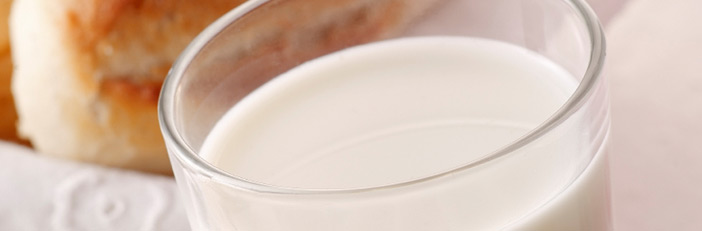
California became the leading milk-producing state in 1993 and has led the nation in milk production ever since. California milk exceeds federal standards for calcium and other vitamins and minerals. Studies show that calcium found in nutrient-rich milk strengthens bones and helps prevent osteoporosis.
A Definition
Milk is produced by all mammals to nourish their young. Cow’s milk is also a nutrient-dense food for humans. Most milk sold commercially in the U.S. comes from dairy cows. Milk is naturally rich in calcium, vitamin D, protein and potassium.
The Facts
More than 7,000 years ago, domesticated cattle appeared along the Tigris and Euphrates river valley, the origin of the first agricultural society of the Sumerians. The ancient Egyptians made cheese, and Isis, the Egyptian goddess and patroness of agriculture, is often represented as a woman with the horns of a cow, a sacred animal. Dairy cattle are not native to the Americas and were introduced to the New World by the Spanish and English.
California is the nation’s leading dairy state and produces more milk than any other state. The California dairy industry employs the highest standards in the nation, using the best techniques for dairy farm management, herd health and milk handling.
The Process
Dairy cows produce milk for 10 months after they give birth to their calves. During this time, they produce approximately 8 gallons of milk each day.
Pasteurization is the process of heating milk to destroy disease-causing microorganisms and to increase shelf life. Various time and temperature combinations can be used for pasteurization, with higher temperatures requiring less time.
Homogenization is the process of breaking up the milkfat in milk into very small droplets and dispersing it throughout the milk. Homogenization prevents the cream from rising to the surface and produces milk with a smooth, uniform texture.
Fortification is the process of adding nutrients to the milk to replace nutrients lost during processing or to improve the nutrient profile of a product. For example, vitamin D is added to most fluid milk marketed in the U.S. and vitamin A is added to all reduced-fat, low-fat and nonfat milk. In addition, concentrated nonfat milk can be added to increase the content of nonfat milk solids such as protein and calcium.
Storage and Handling
- Store fresh milk in the refrigerator, which is typically set at 38ºF-40ºF. Keep it in the closed container in which it is sold to prevent absorption of other flavors.
- Milk and other fluid dairy products are stamped with a “sell by” date, which refers to how long the retail store can keep the product for sale on the shelf.
- No matter what the “sell by” date says, if milk has an off odor or taste it is best to discard it.
- Do not leave milk sitting on the counter for more than a few minutes and never return unused milk to the original container.
- Freezing milk is not recommended as it causes undesirable changes in milk’s texture and appearance.
- In the case of buttermilk, separation normally occurs as it sits, so shake well before using.
- Ultrapasteurized cream keeps several weeks longer than pasteurized cream or half-andhalf, but once opened, it should be handled like pasteurized cream and used within one week.
Nutrition
Milk that meets California’s standards contains more protein, calcium and other nutrients than milk that meets federal standards. Fluid milk sold in the U.S. must meet minimum standards set by the U.S. Food and Drug Administration regarding fat and nonfat milk solids content, but California has its own, higher solid standards for milk.
Milk is high in calcium, phosphorus, riboflavin and vitamin D, and is a good source of high-quality protein and vitamin A. An adequate intake of calcium helps to reduce the risk of osteoporosis. Studies show calcium in dairy products can aid in the prevention of hypertension and colon cancer. California milk makes it easy to meet daily calcium needs.
Whole milk naturally contains vitamin A in the milkfat, but reduced-fat, low-fat and nonfat milks are fortified with 2,000 International Units (IU) of vitamin A per quart. Most fluid milks are fortified with 400 IU of vitamin D per quart, which improves calcium absorption. While milk contains some cholesterol, milk can easily be incorporated into the diet without exceeding recommendations of 300 mg of cholesterol per day.
Compositional Standards
| Standard | Federal | California | |
| Grade A Pasteurized Milk | Milkfat Minimum | 3.25% | 3.5% * |
| Milk Solids-Not-Fat (SNF), minimum | 8.25% | 8.7% * | |
| Total Milk Solids | No Standard | 12.2% Minimum | |
| Grade A Reduced Fat Milk | Milkfat | Maximum 2.1% No Minimum |
Maximum 2.1% Minimum 1.9% |
| SNF, minimum | 8.25% | 10.0% | |
| Grade A Lowfat Milk | Milkfat | Maximum 1.2% No Minimum |
Maximum 1.1% Minimum 0.9% |
| SNF, minimum | 8.25% | 11.0% | |
| Grade A Nonfat Milk | Milkfat | 0.20% | 0.20% |
| SNF, minimum | 8.25% | 9.0% |
While our standards may be stricter than the federal standards, this is not meant to imply the federal standards allow for unsafe milk.
* The minimum % of Milkfat and Milk Solids Not Fat required may vary by no more than 0.1%, provided the total combined % of milkfat and SNF ≥ minimum required % TS (12.2).
| Nutritional Content of California Milk (per 1-cup serving)* | ||||||
|---|---|---|---|---|---|---|
| Calories | Milkfat (g) |
Protein (g) |
Carbohy- drates (g) |
Calcium (mg) |
Cholesterol (mg) |
|
| Whole Milk | 149 | 8 | 8 | 12 | 276 | 24 |
| Reduced-Fat Milk (2% fat) |
122 | 5 | 8 | 12 | 293 | 20 |
| Low-fat Milk (1% fat) |
102 | 2 | 8 | 12 | 305 | 12 |
| Nonfat Milk | 83 | 0 | 8 | 12 | 299 | 5 |
| Acidophilus (2% fat) |
135 | 5 | 9 | 14 | 322 | 20 |
| Buttermilk | 102 | 3 | 9 | 10 | 305 | 9 |
* Bill Green et. al. Nutrient Content of Eight California Milk Products. Dairy, Food and Environmental Sanitation. October 1992. Calcium and protein values above differ slightly from numbers in “Nutricional Comparison of Fluid Milk” chart, page 2, due to natural variation that occurs during experiments.
Cooking with Milk
- Milk is used to add moisture, flavor and texture to many recipes, including custards, sauces, soups, scalloped potatoes, cookies, cakes and breads.
- Milk can replace cream in baking to reduce fat in recipes.
- Cooking with milk is an easy and flavorful way to add calcium and other nutrients to foods.
- Milk in baked goods encourages browning. To enhance the color of a piecrust or loaf of bread, brush it with milk before baking.
- To heat milk, place in a pan over gentle heat, stirring to prevent scorching. If a skin forms simply skim it from the surface.
- Sweetened condensed milk will caramelize when cooked slowly and can be used as a shortcut to a creamy caramel sauce. The can should be emptied into an open container and heated on the stovetop, in the oven or in the microwave.
- Milk can be heated or steamed for hot milk drinks and espresso. Usually reduced-fat and skim milks are more easily foamed. The milk should be as fresh as possible, since milk that has begun to sour can curdle when heated.
- The tradition of drinking warm milk before bedtime is due in part to the science of heating milk to release tryptophan, an amino acid that has shown to aid in falling asleep, and in large part to the effect of an overall feeling of satiety, comfort and decreased stress from drinking the warm beverage.
Glossary of Terms
Whole Milk produced under California standards contains at least 3.5 percent milkfat and 8.7 percent nonfat milk solids.
Reduced-Fat Milk (2%) produced under California standards contains at least 2 percent milkfat and 10 percent nonfat milk solids.
Low-Fat Milk (1%) produced under California standards contains at least 1 percent milkfat and 11 percent nonfat milk solids.
Nonfat Milk (also called “skim” or “fat-free”) produced under California standards contains no more than 0.2 percent milkfat and at least 9 percent nonfat milk solids.
Buttermilk is made from low-fat or nonfat milk to which a culture of Streptococcus lactis is added to thicken and flavor the buttermilk, commonly known as “cultured buttermilk.” Traditionally, buttermilk was the low-fat liquid remaining after churning cream into butter.
Sweet Acidophilus Milk contains a bacterial culture of Lactobacillus acidophilus. After drinking acidophilus milk, the culture may help people digest the lactose (milk sugar) present.
Ultra High Temperature (UHT) milk is processed at higher pasteurization temperatures than those used for regular pasteurization and for a very short time, which sterilizes the milk. UHT milk is packaged aseptically (inside sterile boxes) and can be stored without refrigeration for up to three months. Once opened, UHT milk should be refrigerated.
Evaporated Milk is produced by removing 60 percent of the water. The concentrate is then homogenized, canned and sterilized. Evaporated milk can be stored unrefrigerated until opened.
Evaporated Nonfat Milk is a concentrated, fortified (vitamins A and D) fat-free or skim milk that is canned and sterilized.
Sweetened Condensed Milk is produced by adding sugar to homogenized milk and removing about 50 percent of the water. The sweetened concentrate is canned and the final product contains about 44 percent sugar, which helps preserve the condensed milk. Cans of sweetened condensed milk can be stored unrefrigerated until opened.
Dry Milk is produced by removing about 97 percent of the water from pasteurized nonfat milk. Dry forms of whole milk, low-fat milk and buttermilk are also produced commercially, but have a shorter shelf life.
Milkfat refers to the group of lipids naturally found in milk, including both saturated and unsaturated fatty acids. Whole milk is about 3.5 percent milkfat.
Milk Solids are the lactose (milk sugar), protein, minerals, calcium and enzymes naturally found in milk.
Fortified Milk refers to the addition of vitamins A, D and other nutrients to most commercial milk. Vitamin A is added back to replace loss when low-fat, reduced-fat and nonfat milk is processed. Vitamin D is found naturally in milk and is often fortified with additional vitamin D which promotes the absorption of calcium. Nonfat milk solids may be added to some nonfat milk to improve its appearance, flavor and nutritive value. All fortifications to milk must appear on the label.
Flavored Milk such as chocolate and strawberry are typically made from nonfat, low-fat or reduced-fat milk to which flavor and sweeteners are added. The milk is just as nutritious as its unflavored counterparts.
Sources
Dairy Council of California
Mariani, John. The Encyclopedia of American Food and Drink. New York: Lebhar-Friedman Books, 1999
National Dairy Council